

|
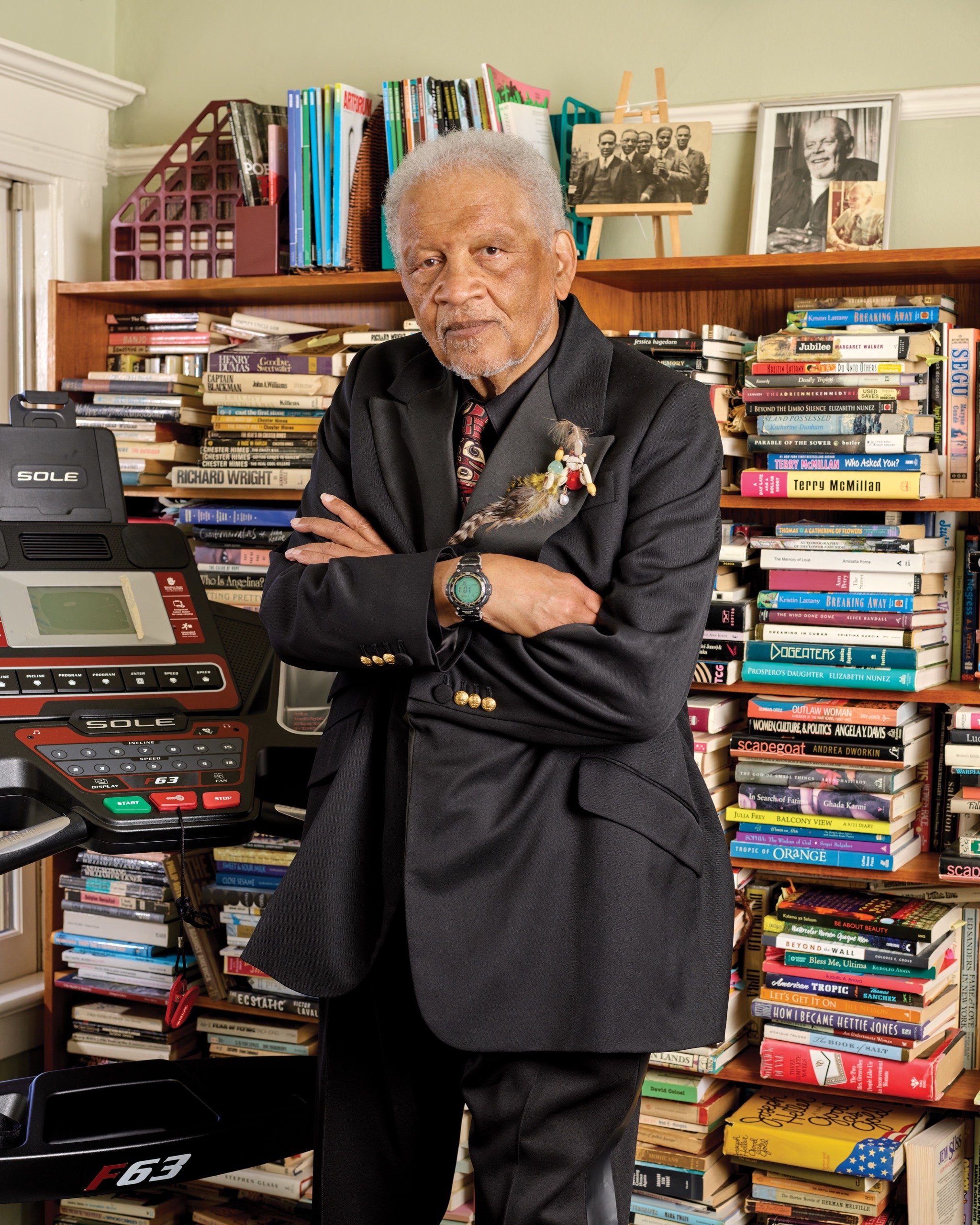
A Conversation with Stanley Elkin
By Peter J. Bailey Wednesday, February 20, 2008
When I visited
Stanley Elkin at his University City, Missouri, home in the fall of
1992, he was in the process of reading galleys for his then-forthcoming
book, "Van Gogh’s Room at Arles." Elkin was capping off a very prolific
decade with the novella collection, a remarkably productive decade for
a writer who had resolved to stop writing novels after the publication
of "George Mills" in 1982: he had published three novels—"The Magic
Kingdom" (1985), "The Rabbi of Lud" (1987), and "The MacGuffin"
(1991)—as well as a collection of essays, "Pieces of Soap" (1992).
"Harper’s Magazine" had just accepted his essay "Out of One’s Tree: My
Bout with Temporary Insanity," in which he describes the derangement he
suffered as a consequence of doses of prednisone, an anti-inflammatory
agent used in the treatment of multiple sclerosis. In that essay Elkin
describes a bookcase in his upstairs hallway "high as a door and wide
as a desk" which he calls the "Wall of Respect," its shelves containing
"all the books I’ve ever written along with their British editions, and
all the books I’ve written that have been translated, and all my
paperbacks, and all the essays, introductions and prefaces I’ve done,
and all the anthologies in which my work has appeared, and the
magazines, anthologized or not, in which it "first" appeared, and the
interviews I’ve given, and the articles, chapters and books about my
work," and much more Elkiniana. What frightened and depressed him most
during the two weeks in which he was out of his head, he explains in
the essay, was the conviction that he hadn’t written the books in that
bookcase, that the anthologized stories were somebody else’s work, and
that all the reviews and critical analyses collected in its shelves
dealt with some other writer. On the mid-October weekend when I
interviewed him, Elkin sat a few feet from the "Wall of Respect," now
moved into his study, answering questions about the oeuvre which,
having been restored to him, could only be his. PETER J.
BAILEY: Your fiction seems to have become increasingly preoccupied with
mysteries—particularly in the intrigue Druff stumbles on in "The
MacGuffin"—but I take it from your essays that you’ve never been a fan
of mystery novels? Why not? STANLEY ELKIN: Because the mystery
novel does only one thing or has only one place to go. I used to teach
a course called the art of the novel—a course in genre novels. I’d
teach a pornography novel, a kid’s novel, a science fiction, a
best-seller, and a "good" novel, and I always taught a detective novel.
And it was astonishing to me how frequently in detective novels nothing
happens but a kind of catechism between the detective and his
suspects—it’s nothing but questions. "Where were you on the night of?"
"On that night I wasn’t anywhere—I was out of it, I was out of town
that night." You could turn to almost any page. Half the dialogue would
be an answer to the question. It’s the seesaw rhythm that the genre
falls into that finally is not very engaging. Another thing
about the detective novel is that it has no protagonist. The detective
really has nothing at stake, except that he’s looking to solve a
puzzle, looking to solve a problem. It’s like writing a novel about a
mathematician, who’s worrying about, you know, whatever mathematicians
worry about, and you read the process of his solution to the problem.
That makes a mathematician, but it does not make for a protagonist.
Nothing happens to the guy. The detective is going to come out on
top—you know that he’s not going to die in the end. So he’s in control,
and it seems to me fiction is about people who are not in control. At
any rate, you’re right, "The MacGuffin" is a kind of mystery. But Druff
isn’t trying to solve anything. He is, and he ain’t. He ain’t in
control. PB: Do you agree with Druff that solutions are always less interesting than the mysteries? SE:
Oh yes. Oh yeah, that’s always true. Think of any thriller movie. I
mean they’ve really got you going, you’re biting your nails, sitting on
the edge of your popcorn, and then somebody comes crashing through the
window with a gun and takes the knife away from the person who’s going
to kill the guy who’s in trouble. You know, not god from the machine
but the hero from the machine. That’s the solution. One of the things
about this movie that was so praised a couple of years ago—"The Silence
of the Lambs"—I couldn’t stand that movie, because they set the serial
killer up as a brilliant, brilliant sociopath eater of women, eater of
flesh. The FBI comes to him to find out what kind of guy would do such
a thing to another human being. And he answers, "Ah, it just so happens
he was my patient when I was a psychiatrist." This is some brilliant
guy. And it’s "always" like that. The first shot, though, when
she’s walking down that corridor and you see him in that cage—that’s
stunning, that’s really stunning. But once you finally get used to him
in his cage . . . I mean, everybody’s gotta be "somewhere." PB:
The mysteries in your fiction (especially from "George Mills" forward)
are, for the most part, deliberately limited, distinctly intricate
human fabrications a la Alexander Main’s creation of Crainpool. Is
there a danger that in pursuing the humanly commensurable mystery of
Crainpool’s whereabouts, Main might too quickly disregard larger
mysteries, more profound enigmas? SE: I don’t think he
disregards larger mysteries. I think what happens is an anticlimax.
It’s exactly what I said about "Silence of the Lambs:" he attributes
almost supernatural gifts of criminality to OYP and Glyp, and they turn
out to be common thugs and car thieves. PB: Main turns Crainpool into a mystery he can solve. SE:
And frees him. He depends on Crainpool for the excitement of there
being somebody who can get away from him. He "wants" a mystery he can’t
solve. PB: One temptation critics often succumb to is finding
a resonant line in a writer’s fiction and designating it (and the work
in which it appears) as a watershed, a turning point in his or her
fiction, as the annunciation of a literary or philosophical change of
direction. The line in "The Making of Ashenden" saying that the
protagonist would "book passage to somewhere far, someplace wild,
further and wilder than he has ever been before" would, then, be read
as a declaration that your fiction would take a direction still more
extravagant and extreme. Is this kind of interpretation pure critical
fiction, or is there some validity in reading protagonists’ fates as
allegories of their creators’ aesthetic directions? SE: No,
no. When Ashenden says that, he means it for Ashenden—it has nothing to
do with my fiction, it has to do with Ashenden’s life. I mean, how you
gonna keep ‘em down on the farm after they’ve been fucked by a bear? PB:
It seems to me that a number of your protagonists are betrayed by the
achievement of that which they pursue: Dick Gibson by the audience to
which he gives voice on the radio, Ben Flesh by the creation of a
homogenized America that replicates his demyelinating nervous system.
Does that strike you as a reasonable generalization? SE: Yes,
it seems to me that the fairies and the genies had it right when they
said, "be careful what you wish for, cuz you’re gonna get it." It’s
worked out in my life. I’m not gonna tell you what I wished for, but I
got it. It always comes back, there’s always a catch, and the catch
kicks you in the teeth. PB: In a previous interview you
admitted feeling little sympathy with "literature of exhaustion"
notions of the futility of language. Are you particularly conscious of
your work as a corrective to ideas such as the erasure of the author? SE:
Well, I’m not in battle with the French, who do not sing to me, or of
me, anyway, but I’m going over the galleys of a collection of novellas
that is coming out in March, and I’m so pleased as I read this stuff
aloud to my graduate student who’s helping me correct the galleys that
the language is as good as it’s ever been. This is going to sound
dopey, but I sometimes get emotional at how good I occasionally am. And
I’m not just talking about the fireworks—I’m talking about getting Sam
from one part of the room to the other part of the room. For me,
language is still where it’s at. PB: A writer once told me
that she thought it would be impossible for reviewers to overpraise any
of her novels—that, given the work she’d put into them and the neglect
into which they were likely to fall, no one could ever respond
positively enough to suit her. Would you agree that reading reviews is
necessarily a disappointing experience? SE: Yes, yes I would.
But I find that the good reviews are often just as dopey as the bad
reviews. Except that often, when a reviewer catches something that I’m
deliberately trying to do, that’s sort of touching to me. So, in a way
I don’t agree with her. When the reviewer seems to have a kind of
perfected pitch to the notes I’m sending out, I get all warm and fuzzy. PB:
Many of your novels tend to have very little in the way of specific
news events, book titles, popular songs, or other such signals locating
them in a specific time or place. SE: I don’t think that is
true—as a matter of fact, it’s something I have to watch out for. I
remember when I was writing "The MacGuffin," I had Bobbo Druff
speculating about what he would do if he were President of the United
States. Of course, the cold war was going on then, but it was the cold
war as seen through the peaceable kingdom of glasnost and Gorbachev,
and so in the original manuscript I had references to glasnost and
"peristroika" until I decided that it would be better not to write
something that would have to be footnoted a year and a half later. PB: In one of your previous interviews you talked about not wanting to use details that would immediately be dated. SE:
Right—in "A Bad Man," for example, I had Feldman rhapsodizing about the
fact that he has a color television set. I was writing this in 1964 and
‘65, when color television was very, very rare, but now you see this
guy rhapsodizing about his owning a color television and you think he’s
a madman. So it’s best to stay away from that stuff. As a
matter of fact, in "The MacGuffin," car phones were all new to me . . .
I had been out to California, where everybody seemed to have one, and I
was struck by the car phone, and I thought, this is something that will
never catch on, so I gave Druff a car phone in the limo, but it was
OK—I think I got away with it because of the way he uses the car phone. PB:
More than most writers, your work delves in nearly clinical detail into
extremity, particularly disease. How do you respond to the oft-cited
comment that your terribly deliberate anatomizations of illness in "The
Franchiser," "George Mills," and "The Magic Kingdom" are your acts of
revenge on the disease that has disabled you? SE: No, it’s not
so—there’s no way in the world I could ever take revenge on the disease
that has disabled me. It just seems to me that disease, because it
flirts with death, is a rather important subject to write about. PB: You must have done a fair amount of research to create the seven afflicted children in the "Magic Kingdom." SE:
Absolutely none. I have a friend here who’s a pathologist—I asked him
to give me the names of some childhood diseases, and he came up with
maybe a dozen, and I called the Washington University reference library
and asked them to send me some information about these diseases, and
they were kind enough to Xerox some quite brief explanations of the
diseases, their symptoms, the prognosis, blah blah blah, and that’s the
full extent of the research. I took the symptoms and ran with the
symptoms was what I did. PB: If you were to imagine an ideal response to one of your novels by an ordinary reader, what would it be? SE: I think I’ll go out and buy this for a friend. PB:
Is it fair to say that one of the questions you’re usually balancing in
writing your fiction is how much to let the plot machinery of the work
extrude upon its surface? How much to refer explicitly to the
MacGuffins functioning in the fate of the characters? SE:
Well, Dick Gibson has a sense of having a fate, and the Franchiser has
a prognosis, which would be a kind of plot, wouldn’t it? And Druff in
"The MacGuffin"—it occurs to Druff that he has a MacGuffin, and
therefore he goes out looking for his plot. It’s a total accident—a
coincidence—that he happens to really have one. I was going to
say that plots have become very interesting to me since I started
working with the bubble machine. The word processor has facilitated not
just the mechanics of one’s writing but has actually facilitated plot,
and I’ll tell you why. You write on a word processor: you open the
store in the morning, you do what you do, and then it occurs to you,
gee, wasn’t there some kind of reference to that earlier on? So you put
the machine into the search mode, and you find what the reference was
earlier, and you can begin to use these things as tools, or nails, in
putting the plot together. The word processor facilitates the plot—I
really mean that. When I wrote "The MacGuffin," I was constantly
looking back for general references to certain thematic key words, and
that really tightens the nuts and bolts. Therefore, my plots have
gotten better since I went to work with the word processor, which I did
with "George Mills." The word processor enables one to
concentrate exponentially; you have absolute command of the entire
novel all at once. You can go back and reference and change and fix and
. . . so in a way, all novels written on the bubble machine ought to be
perfect novels. PB: "Plot is people," you argue in the essay "Plot," " ‘But it is never other people’." SE:
What I guess I meant is that plot is persons; it is never people.
There’s got to be that focus on one guy. It’s the agenda of a single
man or woman. PB: And yet the novels many people consider your
best—"George Mills" and "The Magic Kingdom"—encompass a number of
points of view. SE: Oh, I think "The Magic Kingdom" is clearly
Eddy Bales’s story. And "George Mills" is clearly George Mills’s
story—they’re all the same George Mills, finally. PB: All of
the novels you’ve published have been dedicated to Joan Elkin, and yet
you’ve never granted any of your protagonists the boon of a similarly
loyal and valued wife. Is that an index of your notion of necessary
differences between art and life? SE: [laughs] No, it’s
not—it’s because I love my wife. In "The MacGuffin," Druff and his wife
have a perfectly good marriage—he goes out on her for a night in a
whole lifetime, but he comes back to her, too. PB: In your
interview with Tom LeClair some years ago, you insisted that your
fiction—like Faulkner’s, like Auden’s poems—never changed anyone’s
life. Has your opinion on this changed at all? SE: I don’t
really think that fiction changes lives . . . except it can maybe give
you taste—I suppose taste can change your life. PB: Somebody
reads one of your novels, picks up certain rhythms, picks up certain
kinds of ways of seeing things as being like other things—it’s not a
change of life, but . . . SE: Yeah, but you’re not going to go out and buy something. PB: Maybe another Stanley Elkin novel. SE: Probably not. I mean, I think I know most of my readers by name. PB:
In a "New York Times Magazine" article last year, you’re quoted as
saying, "I ride a pretty tight shot gun on myself, believe it or not,
but when, in the course of human events, something occurs to me that
gives a particular kick to a sentence, I’ll probably let it pass." I
think I could identify some of the kicks, but I wonder what, in your
fiction of deliberate excess, represents to you excessive excess, what
kind of thing gets cut? SE: The kind of thing that gets cut I
don’t remember because I cut it. In "The Rabbi of Lud," when Goldkorn
visits Rabbi Petch’s place in Anchorage, and Rabbi Petch is terrified
of weather—there’s an awful lot of weather jokes in that section. I
thought them funny, so I left them in, but I knew I could have done
with a lot less of that. A lot of the stuff in "Rabbi of Lud" is just
silly—I’ll give you a much better example than the Petch thing. The
stuff in Lud, New Jersey. There’s a scene in which he makes a prayer in
front of the "haverim"—this group of Jewish singers—and he’s showing
off for his daughter, Connie, insulting, defying God. That is just so
outrageous, so unbelievable that I should have just—maybe I didn’t
catch myself. If I were to rewrite the book, I would catch myself. But
there are things equally outrageous in "The Rabbi of Lud" that I let
stand because they’re quite wonderful, I think—the business of the twin
Indians who grow apart, the guy with the flowers in his beard and the
flowers finally fade—I mean I think that’s wonderful, I get a kick out
of just thinking about that. In the eulogy for Joan Cohen sermon
Goldkorn goes on and on and on and on and on. That’s cut by 33 percent
and I should have cut another 33 percent. Hit ‘em hard and get out. PB: You obviously have mixed feeling about that novel. SE:
I still think the situation is an essentially good situation—how this
guy destroys his daughter by insisting on being a rabbi in Lud. Another
thing I love in that novel is the revenge scene which his daughter
makes up, the business with the Virgin Mary—I remember having a lot of
fun writing that. But I had no editor on that book, and I needed an
editor on that book—I needed somebody to say "pull your horns in here,
go slow, don’t show off here." Though editors mostly leave me
alone—except for Joe Fox, the editor I had at Random House, I’ve never
had to answer to an editor—"Rabbi of Lud" was a book that could have
used one, somebody to come in with a whip and a chair and say, "get
back, get back." PB: What role did Joe Fox play in your novels with Random House? SE:
Oh, he ran a tight ship—he questioned absolutely everything. And he
would argue with me—and I would argue with him. But he was a wonderful
editor; he was in fact the best editor I’ve ever had. I wrote five
books with him, and he was really tough with me on "Boswell," "A Bad
Man," "Criers and Kibitzers;" he was a little tough with "The Dick
Gibson Show," and not so tough with "Searches and Seizures," because by
the time I got to "Searches and Seizures," I had become a good writer,
I think. PB: So "The Franchiser" was the first without him? SE:
Right. I was left alone with "The Franchiser" and with pretty much
everything after that. But I’ve been blessed—I haven’t had any dumb
editors. PB: Read any good novels lately? SE: When
I’m writing, I tend not to read, and I have been writing. The things
that I read are things that people send me to blurb, and I can’t get
through those most of the time because they’re no good. But Paul
Auster’s "New York Trilogy"—I liked that. Anita Brookner—oh, I think
she’s wonderful. She does things I couldn’t possibly do—wouldn’t know
how to do. I love Bellow—I love his stuff. PB: "More Die of Heartbreak?" SE:
I loved "More Die of Heartbreak:" matter of fact, "More Die of
Heartbreak" was what gave me the idea for writing a political
novel—"The MacGuffin." PB: Did you read Rabbit at Rest? SE:
Oh, yeah, I liked that a lot. I think it’s not the best of the group; I
think "Rabbit Is Rich" is the best of the group. I hated "Rabbit
Redux." When I went back to read "Rabbit, Run," I wasn’t as fond of it
the second time around, but I wrote him a fan letter for "Rabbit Is
Rich"—it was terrific. PB: Has a critic or reviewer ever made comments on one book of yours that had an impact on the writing of your next book? SE: No. PB:
You once traveled to a small college for a reading that has become the
stuff of legend and an object lesson in how not to host a visiting
writer. Care to recall it? SE: Yeah. I was picked up at the
airport by this guy in the English Department in Williamsport, the home
of the Little League, but I didn’t know how little this league was I
was going to be playing in. For those times those days, this was big
money for me—I think it was five hundred dollars for three days’ work,
plus expenses. We got into the car, we start driving towards Lockhaven,
and he doesn’t say anything to me. Then finally he says, "We’re not
going to give you a party." I said, "What do you mean?" "A lot of
people don’t like parties," he says. I said, "Who? Who doesn’t like
parties?" Anyway, he wasn’t going to give me one; he’d take me to the
hotel room, he’d pick me up for the class and drop me off again, but I
was on my own. I sort of didn’t believe him—I didn’t believe this was
going to happen. So he left me at my hotel and told me he’d pick me up
the next day at 10 A.M. This is one in the afternoon. There was a Merv
Griffin festival on cable, so I watched that, and by the next morning
I’m ready to see a human being, and the guy picked me up and took me to
his class, and I did my thing. He brought me back to the hotel—he
didn’t invite me to dinner, nobody gave me dinner, I had dinner at the
hotel, charged it to my room. On the third day he picked me up again
and delivered me to the reading, which wasn’t even in the auditorium—it
was in the "lobby" to the auditorium. And people came—I mean, not a lot
of people, there aren’t a lot of people that go to Lockhaven State
College—and I gave my reading. After the reading, I asked him, "Where’s
my check?"—because I was pretty pissed at this guy. He said, "That
hasn’t been made out yet." "Is it in the mail?" "No, I told you, it
hasn’t been made out yet." So he took me back to the hotel, and I asked
at the desk, "Do you still do room service?" "Oh, yes sir, what would
you like?" "I’m giving a little party in my room. I’d like sandwiches
for about thirty people. I’d like a bottle of scotch, I’d like a bottle
of this, a bottle of that, maybe some canapes—just send it up to the
room and I’ll sign for it." And they did—these fucking trays kept
coming in. I had a sandwich, maybe I had a drink, and I flushed
everything else down the toilet. Nobody’s gonna give me a party, I’ll
give "them" a party. That’s what happened to me at Lockhaven State
College. PB: You’ve been quoted as saying that you feel your
books don’t move some readers. Given the highly emotional content of
much of your work, that seems strange. SE: That was before
"The Magic Kingdom"—I got mail from "The Magic Kingdom," and a lot of
readers—for me a lot—wrote saying they thought that book was moving. I
answer all those letters—hardly get writer’s cramp—but I can’t say my
books don’t move people anymore—not all of them. PB: Do you think of your work as particularly intellectual? SE:
No—I don’t think of myself as inaccessible at all. The language is
high, and the sentences are long and convoluted, but they always come
out right, and if you’re willing to follow me through the dashes and
the parentheticals . . . I don’t think my work is inaccessible. PB: There are some plot maneuvers you enjoy which— SE: There is a certain kind of thing that I picked up from Faulkner, and that’s the business of delayed revelation. PB:
In your introduction to a new edition of "Criers and Kibitzers," you
have some slighting things to say about "the shared communal linkages
between the author and the compacts, struck bargains and done deals of
a reasonable, recognizable morality" that underlie literary realism.
How do you encourage students in your writing classes away from those
easy bargains into the writing of a more expansive, linguistically
sophisticated, imaginative fiction? SE: I had a wonderful
conference yesterday with a graduate student who told me, among other
things, that writers write for emotional reasons, and I said No,
writers do not write for emotional reasons—they write because they want
to make something. I asked her if she knew the Stephen Sondheim musical
with the number about making a hat—"a hat, a hat, I made a hat where
there never was a hat." That’s so moving to me I choke up when I tell
you about it, and I said that’s what writing is about, that’s what all
art is about: you’ve made a hat where there never was a hat! That’s why
people write. I don’t know if that answers your question, but that’s
how I try to engage students to get out of this one-on-one, tit-for-tat
realism: make a thing that never was. PB: "Because aesthetics
is the only subject matter, because style is," your essay " The Rest of
the Novel" contends. Isn’t there a point, though, at which sentences
begin coalescing into themes, ideas, into the magnetic fields of
humanly conceived significance? I guess I’m asking, with David
Dougherty, who’s published a Twayne book on you, whether ideas aren’t
somewhat more prevalent in your work than you sometimes suggest they
are. SE: I don’t think so, I don’t think they are. I mean
there are ideas in my work, yeah, but my work is not idea driven; it’s
event driven and language driven, and, I hope, driven by personality. PB:
"Story in its essence is nothing more than role being faithful to its
nature, I said. The reasonable and recognizable being where it’s at, I
went on. Yes, and didn’t Dorothy have those slippers with her all
along? Aren’t they just standard ordinary issue to anyone from under
the rainbow? So that the furniture you use up in a fiction is only
furniture you’re finished. Nothing up your sleeve unless you put it
there in the first place?" Isn’t this Dick Gibson’s argument that
there’s no astrology, no black or white magic, no ESP or UFOs? That
there’s nothing but technique and the "strange displacements of the
ordinary?" What about Ben Flesh’s transcendent experience of getting a
haircut? What about the dream the children on their dream holiday all
dream? SE: That’s a leap—that’s a stretch on your part, and on
my part it’s meant in a book called "The Magic Kingdom" as a magical
instance. I mean, there are all kinds of magical things that happen in
"The Magic Kingdom;" physics and natural law are in abeyance in that
book. First of all, when they get there, there’s snowfall, but it only
snows exactly on Disney World; across the street, there is no snow. The
phrase that runs through "The Magic Kingdom" is "because everything has
a reasonable explanation." There is no reasonable explanation. So "The
Magic Kingdom" is one book, and another book is another book. I think
that when Dick Gibson says all there are are the "strange displacements
of the ordinary," he’s talking about the people who appear on his show
trying to steal his voice—Behr-Bleibtreau, whose way of doing it is to
try to strangle him. Gibson at the end of this long night’s journey
into day is fed up with the hocus-pocus of self-proclaimed magi; it’s
the last time he has such a talk show. What I’m really saying, I guess,
in that quote from "The Rest of the Novel" is that it’s true that the
only thing the writer works with is what the writer works with, is what
the writer has allowed . . . he creates the parameters from the
beginning of the novel. From the beginning of "The Magic Kingdom," you
know there’s gonna be magic. You can’t change the game plan in the
middle. PB: Would it be reasonable to say that Eddy Bale
interests you less than other characters in "The Magic Kingdom" because
there’s nothing he wants to do in room 822? SE: No—Eddy Bale
probably interests me more than any of the characters in "The Magic
Kingdom." The kids are freaks. But Eddy Bale has sustained a real loss
and suffered heavy casualties. He gets this mad idea that no other
children must die. Of course they’re gonna die. And he ends up with
Mary Cottle in room 822 in the last chapter. What happens at the end
suggests that every time you fuck, you create a monster. PB: Is "The Magic Kingdom" finally critical of his project—of his dream holiday scheme? SE:
Oh boy. Oh boy. I got the idea for "The Magic Kingdom" when I was in
England. On the television news there was this three-minute special
interest piece about a bunch of British children who were being
schlepped to Disney World Florida—they all wanted to see Mickey
Mouseville. You know, I was never going to write another novel after
"George Mills"—I had decided I didn’t want to write any more novels.
And I was watching this thing, and I began to choke up, because I had
never heard of terminally ill kids being taken. And they showed these
kids: they were the lame, the halt, the blind, the failing—they were in
terrible shape. And I thought, my God how are these kids even gonna
make it across the ocean, much less make it back? And I told Joan, I
said I had an idea for a novel; it would be terrible to write such a
novel, but it’s a good idea for a novel. Now the challenge of "The
Magic Kingdom" is to write the novel and not make it sentimental. And I
don’t think it is sentimental. I hate the idea of a Last Wish society
and all that. PB: One way of asking a question about the
inevitabilities implicit in plotting might be this: In writing "The
Magic Kingdom," did you become aware first that one of the children
would not survive the dream holiday, or that Rena Morgan would be the
one who wouldn’t? SE: No, I knew that one of the kids was not
going to survive; I didn’t know who wouldn’t. It was love—it was beauty
killed the beast. It was love that killed the kid because cystic
fibrosis is a lung disease, and she can’t get past the orgasm. The
punishment fits the crime. PB: This is probably a question for
critics to ponder more than for you to answer, but let me try it
anyway: Is it possible for a man who once affirmed that the only
psychological assertion he swears by is that "the SELF takes
precedence" to write a book that, as your note on "The MacGuffin"
designates it, is "a political novel?" SE: Well, when you
write a political novel—by that I meant politicians. With politicians,
the self "does" take precedence, I assure you. PB: Dick Gibson
wants to live a life of cliche; Bobbo Druff experiences his MacGuffin
as a principle of structure, as his life’s latent architecture. Does
"The MacGuffin" strike you as a novel which, in more somber tones,
reprises some of the themes of "The Dick Gibson Show?" SE: No.
I think "The MacGuffin" is superior to "The Dick Gibson Show" because
it’s constructed so much more carefully—I had a bubble machine. I
thought "The Dick Gibson Show" had a plot, but it wasn’t as careful a
plot as "The MacGuffin;" it was more the fireworks of episode. PB: Good episodes. SE: Right, but put ‘em all together and I’m not sure they spell mother. PB:
You’ve often said that "fiction gives language an opportunity to
happen." The book of essays you’ve recently published suggests that
nonfiction provides something of the same opportunity. How, in your
mind, do the opportunities differ? SE: They don’t. I never
consciously planned to write a book of essays, but after I finished The
"MacGuffin," I wanted to get magazine assignments. "Harper’s" gave me a
wonderful assignment: cover the Academy Awards. And I got a series of
other assignments, and it came to me that I had enough essays to do a
book. I’ve noticed that all the recent essays tend to be
autobiographical. There’s one coming out in "Harper’s" which is totally
autobiographical—it’s about my experience of temporary insanity. So I
guess I talk about myself in essays. The essay is an opportunity for
language to happen to "me." PB: At a time when the
protagonists of novels are frequently dramatized as victims, your
characters—I’m thinking specifically of Ben Flesh, Elerbee, Eddy Bale
and some of the children he brings to Disney World, and Bobbo
Druff—refuse to take on the victim’s mantle or strike conventional
poses of victimization. Would you comment on that? SE: No, but
I would thank you for asking that question, because when I was first
reviewed, again and again I was classified as an absurdist or a
stand-up comedian or a this or a that, but most frequently the thing
they had to say about my characters was that they were losers. I never
regarded them as losers. The guy with the most energy was the winner.
Was it Bellow or Roth who invented the term "victim literature?" I
guess it was Bellow. And Bellow had repudiated victim literature after
he wrote "Herzog." He said there’d been too much victim literature. I
don’t see that his characters have essentially changed, but I don’t
regard Bellow’s characters as victims either. PB: David
Dougherty suggests in his Twayne study that "The Franchiser" was
originally conceived and the writing begun without any notion of Ben
Flesh being afflicted with M.S. How did you originally conceive of that
novel’s progress? SE: I got the idea for "The Franchiser" from
an article in "Time" magazine about Kentucky Fried Chicken, and it
occurred to me that a novel about a guy who has franchises would be a
terrific novel to write. I was writing "The Franchiser" in 1974; my
M.S. had been diagnosed in 1972, but it never occurred to me that Ben
Flesh was going to have M.S. But then it seemed to me that the symptoms
of the disease would be a nice metaphor for the energy crisis. I meant
"The Franchiser" as my bicentennial novel—it did come out in 1976—and I
wanted to make a statement about America and its loss of energy. PB:
Most reviewers and critics acknowledge the craftsmanship of your prose,
but I do wonder if the imaginative range of your work is sufficiently
recognized. The dodo scene in "The Dick Gibson Show," the entire
conception of "The Living End," the Crusades section of "George Mills,"
and the character interactions in "The Magic Kingdom" seem to me
extraordinary deeds of literary contrivance. Do you agree that literary
fabrication is an underappreciated strength of your work? SE:
You betcha. It’s always seemed to me that the best kind of book is the
open-ended book where anything can happen. I hate a book which has one
premise, and the writer sticks to that premise so tightly that the
writer has no room to breathe—the reader has no room to breathe. PB: Is it fair to say that you write your novels to be reread, not just read? SE: No, that’s not fair to say. I don’t even write them to be read—it certainly ain’t happening. PB: If there were a "Stanley Elkin’s Greatest Hits II,"s what would be in it? SE:
I regard everything from "Searches and Seizures" on, with the exception
of "Rabbi of Lud," as pretty good stuff. If "Rabbi of Lud" had had an
editor, it would have been a good book. PB: You’ve said that
fiction says yes or no. Assuming that your fiction primarily says yes,
I wonder which work you think says yes most emphatically and
effectively? SE: Actually, I think they all do, but probably
"The MacGuffin." Because Druff has his night on the town and
deliberately drags himself home; he forgives Mikey, he accepts his life
more than any other of my characters do, so I suppose it would be "The
MacGuffin." Also The Franchiser. "The Franchiser," of course, says
yes—he says "ah." But his yes is sort of muscling through, and it’s
kind of chemical—it’s kind of a chemical yes. He’s gonna feel rotten in
the morning. From |
|