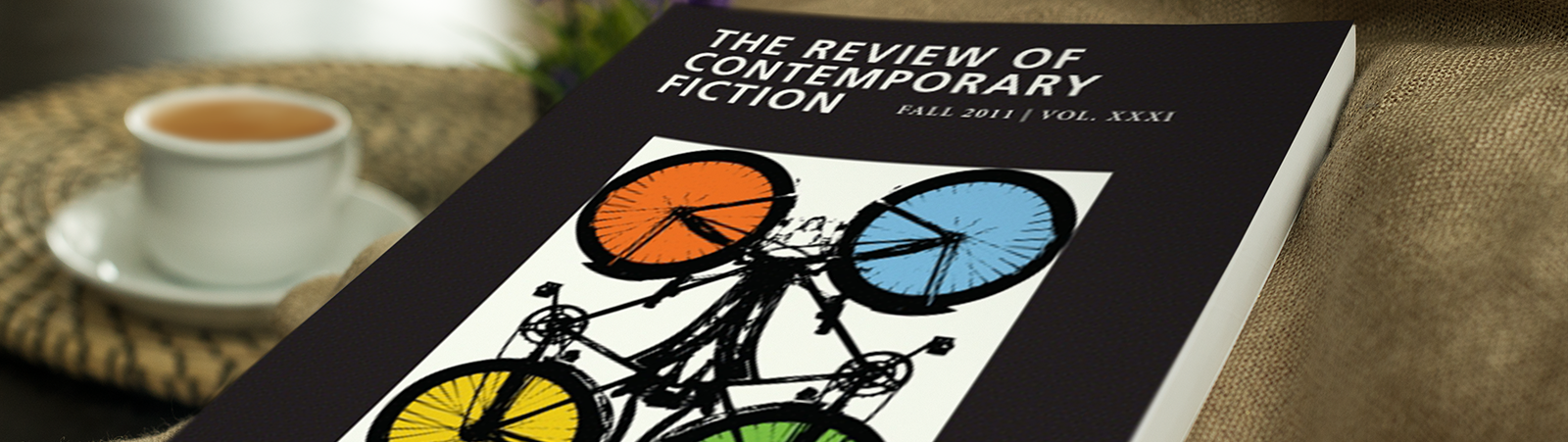
![]() |
Book Description
Seventeen years after the publication of the first volume of Jacques Roubaud's epic and moving The Great Fire of London, Dalkey Archive Press is proud to publish the first English translation of The Loop, the second novel in Roubaud's Proustian series, which has in its capacity to astonish been compared to the compositions of Messiaen and the buildings of Antonio Gaudi. Devastated after the death of his young wife, Alix, the author conceives of a project that will allow him not only to continue writing, but continue living—writing a book that leads him to confront his terrible loss as well as examine the lonely world in which he now seems, more and more, to exist: that of Memory. The Loop finds Roubaud returning to his earliest recollections, as well as considering the nature of memory itself, and the process—both merciful and terrible—of forgetting. Neither memoir nor novel, by turns playful and despairing, The Loop is a masterpiece of contemporary prose.
About the Author
|
Jacques Roubaud, born in 1932, has been a professor of mathematics at the University of Paris X Nanterre and is one of the most accomplished members of the Oulipo, the workshop for experimental literature founded by Raymond Queneau and François Le Lionnais. He is the author of numerous books of prose, theatre, and poetry. Most notably, Dalkey Archive Press published two of his Hortense novels—Hortense Is Abducted and Hortense in Exile—his poetry collections Some Thing Black and Plurality of Worlds of Lewis, and his novels The Loop and The Princess Hoppy, or The Tale of Labrador. |
![]() |
About the Translator
| Jeff Fort was recipient of the French-American Foundation's prize for his translation of Blanchot's Aminadab. In 2007 he was given a fellowship at the Camargo Foundation in Cassis, France, to work on The Loop. He is assistant professor of French at the University of California, Davis. |
Praise
"[The Loop] is a childhood autobiography, a tour de force of improvisation, a storehouse of poetical, philosophical, logical and historical treasures, and without doubt Roubaud's most impressive work to date . . . no amount of rereading will ever quite exhaust the imaginative potential of this sparking, encyclopaedic panorama of one of the most fascinating and well-furnished minds of our time."—David Bellos, Times Literary Supplement"Roubaud is a humorous and sometimes earthy writer whose work can be enjoyed by a wide variety of readers."—San Diego Tribune
"Roubaud's book is remarkable . . . The Great Fire of London is an entirely sympathetic book to read, but in its careful organization it is also a heartening one, as showing the power of artifice to manage even the keenest of distress."—John Sturrock, Times Literary Supplement
More Information
Also by Jacques Roubaud:Hortense in Exile
Hortense is Abducted
Princess Hoppy or, The Tale of Labrador
Some Thing Black
The Form of a City Changes Faster, Alas, Than the Human Heart
The Great Fire of London: A Story With Interpolations and Bifurcations
The Plurality of Worlds of Lewis
During the night, the mist on the window had turned to ice. I see that it was still night, six-thirty, seven o'clock; wintertime, then, and dark outside; no details, only darkness; the windowpane covered with the patterns of the frozen mist; on the lowest pane, on the lefthand side of the window, at eye level, in the light; this light from an electric bulb, yellow against the intense darkness outside, opaque and wintry, clouded by the mist; not a uniform mist, as when it rains, rather an almost transparent frost, forming patterns; a web of translucent patterns, with a certain thickness, the slight thickness of frost, but with variations, and because of these miniscule variations in thickness, the frost formed patterns on the glass, like a vegetal network, an entire system of nerves, a surface vegetation, a cluster of flat ferns; or a flower.
I scratched a fingernail against this snow, this fake snow: neither white nor powdery; nor melting snow, but a kind of fading snow, the dirty snow of springtime lingering on the sidewalks under the boxwood trees; or rather crushed snow, worn down, dusty and colorless, ephemeral; with my fingernail I traced a path on the glass, and the crystallized mist accumulated against my finger, turning to water from the warmth of my finger, quickly disappearing in tiny rivulets and evaporating into a damp coldness on my numb finger; or else I held my palm flat on the glass, and under its pressure the clump of frost became a sheet of glassy ice, so that suddenly the night showed through, almost watchful in its proximity; the whole vegetation of frozen traces, with its imaginary petals, stamens, and corollas, was erased; now it was smooth, like glass on glass: the map of the hand, the sensitive network of its lines, left no imprint. [--> I § 51]
Still using my fingernail, very carefully, I was able to slide these blades of ice over the surface of the glass, toward the bottom, placing them next to one another in polygonal figures, fractured rectangles; the upper half of the windowpane then seemed to be bare for a moment, immediately adjacent to the night, contiguous with this still impenetrable mass, blue and somber; but only for a moment, for it was soon covered in mist: a fine mist, impartial and isolating, this same mist that floated through the air in a cloud, born from respiration; at every moment this breath-turned-mist held the nocturnal exterior at bay; if I rubbed it with my elbow, with my pyjama sleeve, it reappeared immediately. From this thicket of images one could deduce that it was also cold inside the room, perhaps a little less cold than outside, so that the mist would stick to the window, but cold enough for the air to condense these frozen vocables (I see them), as though they had fallen from a silent voice.
But this would mean indulging in a superfluous exercise of deduction, since at the very moment of saying it, before saying it, I know it; my memory knows it, and it does not lie. I do not mean that a memory is, or is not, sincere, but only that, like a dog, it cannot lie (no doubt a lie is only an act of saying, an act of speech, turned outward). It really does appear this way, in this image; and every image is undeniable. Memory, my memory, knows that it was so: It was nighttime, and it was winter; it was cold; cold outside, cold inside the room; I scratched with my fingernail, I let accumulate against my nail the granite of foggy crystals from the mist, I lay my hand against the pane, I pressed it with my face, with my breath. And yet, every line in the story of this memory contains a great many implicit conclusions. And it is here that error, if there is any error, lies in wait for me at every turn. For in memory, in my memory (I am speaking only for myself), there is only seeing. Even touch is "colorless," anesthetized. I have no other adjectives to identify this apprehension of material things by thought alone, without form or sensuous qualities, as they arise in their grey and pasty conceptual clay (as certain early theories from Antiquity pictured it). In the process of remembering, I do not feel that my finger is cold, nor do I feel the mild and already fading sharpness of the scraped and frozen dust. I know--because it is commonly and universally known that frost exists and that this mode of the physical existence of water is cold--I know, therefore, that the night was cold, and everything that follows from this. And I recall this knowledge based on experience, as one says. But the image that I reconstitute at this moment is numb to this knowledge, it is indifferent.
Writing on glass is like writing on water: regardless of what one tries to inscribe on these surfaces, such writing is also a metaphor for the ephemeral nature of everything. A mythifying fiction has sometimes tried to convert this into its opposite, by inventing a message engraved on eternal glaciers and in the deep polar snow, uniformly protected by its whiteness, a kind of immense graffiti--indeed, preferrably of colossal proportions--and preferrably in an incomprehensible and therefore immortal language, presenting a truth at once indispensible and indecipherable. From the moment one masters the gestures of writing, and probably for some people up until the hand ceases its movement, there is a desire, mixed with anguish, to write words and signs that can be immediately erased: in sand by a wave, in dust by footsteps, under the eraser with a pencil, or from water, rain, time, or tears smudging the ink.
It was winter, most likely a wartime winter: 1938-1939, at the earliest, 1944-1945 at the latest. I could not have been in this room before that, or after. It was toward the end of night, since the mist had frozen. A very cold night, which was a rare phenomenon. It doesn't freeze much in the Aude region. I try to think of a very cold winter: 1940? 1942? There was at least one very cold winter during that war. It long remained in everyone's memory, including my own, and was all the more memorable because people did not heat their houses, at least we didn't. Our bedroom was not heated. If this image is correct, and pure, if it is not distorted or mixed with others, through resemblance, confusion, or mere repetition, if it is indeed the lower pane of the window that I see, then it must be the earliest, the first possible winter. But as soon as one breathes on any image, any memory, it is covered with mist, and reveals itself to be thoroughly imbued with imprecision. Around it is the past which, like the dark night of that winter, is impenetrable.
To the left of the window, I see my bed: this is another image, another moment, or the same? I don't know. I feel the cube of the room around me, the bed square in the corner against two walls, lengthwise in relation to me, behind my head; a little farther, the door opens, is open (this "around" belongs to vision which, like light, is sometimes able to "turn corners"). Of certain bedrooms, certain beds, I can evoke only a single image that always remains the same, and everything that is not in this image remains hermetically sealed to me. But of this old room I have a multiple but unified vision, assembled like a collage, through the superimposition and then the fusion of numerous separate visions that have since become indiscernible, beginning from a particular point, the one from which "this" is seen, a central point, at the top of the bed, almost in the corner. There is a "top" and a "bottom" of the bed, as if while lying in it one imagined oneself as vertical, the "point" of vision being at the top of the "page." It is there that, in a letter, one puts the address of the sender. No colors, no, there are no colors. To see gathered together in this way all the other images from this same place, the fingernail on the frost-covered window, the nighttime windowpanes, what the daylight will make visible through the window, all this assumes multiple eyes, innumerable hands. Whoever remembers is at once an Argos, a creature with a hundred eyes, and an octopus, a creature with a hundred arms.
In the cold, my bed was divided into different regions, warm and cold; the intense cold bordered sharply on the warmth; it pinched my ears, my nose. Here, then, is something truly "inevitable," the very banality of temperature. In the evening one conquers as many territories of the cold as possible, waging battles analogous to a Russian campaign, which provided a strategic model for this game of conquest, renewed night after night (I'm not speaking of the historic one, the disastrous Napoleonic campaign, but of the one that unfolded at the time, and contemporaneously, in the immense bed of the Ukraine, which was unveiled for us every evening on the radio from London, with the "allied" victories confirmed, after a delay, when the radio from occupied Paris announced the new "elastic retreats" of the Germans). The Siberian regions of the three edges, bounded by the vertical sides of the mattress and the covers that were tucked in well underneath it, always remained impervious to comfort; in the morning, the diffuse warmth of the sleeping body had reduced the pockets of resistance, that Stalingrad with its armies of ice.
In that room there were two other beds that I see; on the other side of the window, my sister Denise's; at the far end (still looking from the same point) my brother Pierre's, to the left of the door; seen from the door, on the contrary, this layout, which was of parental origin (I mean it was decided by our parents), organized the space of the bedroom according to the age of its occupants (that is, if one grasps this space in the movement of sight, as I am in the habit of doing, and as if the flat surface of the world, and not only that of the bed, had become vertical, it too like a page: from left to right, and from top to bottom). It seems to me that the spartan light did indeed come from a naked bulb on the ceiling; just about all the rest has disappeared.