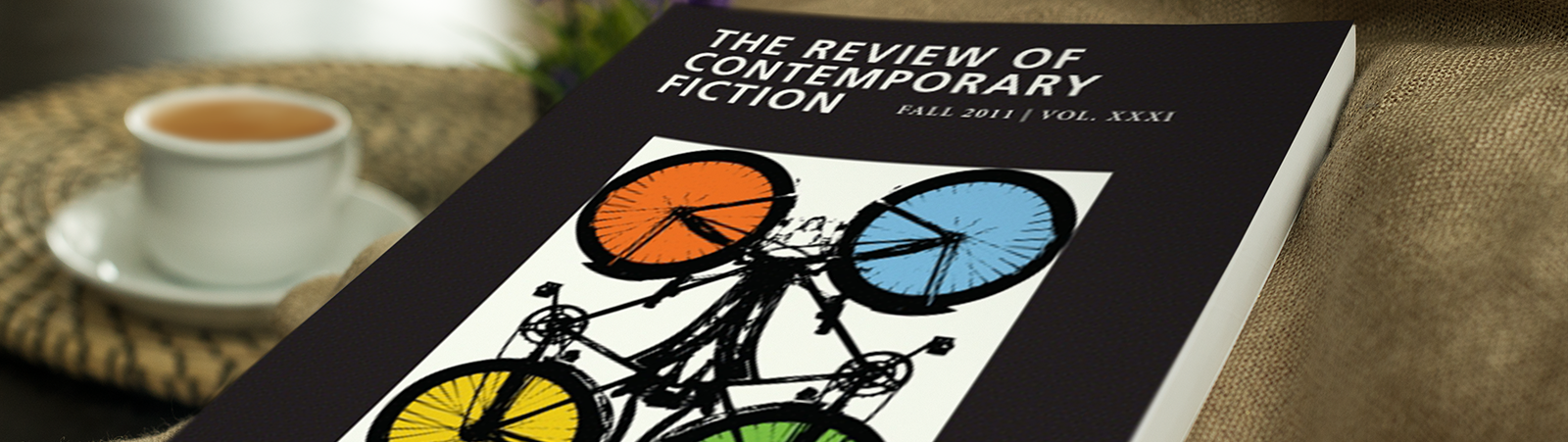
Context N°15
With Jonathan Bolton, Anne Burke, Jessa Crispin, Eric Dickens, Ariel Dorfman, Max Frai, Dmitry Golynko-Volfson, Sophia A. McClennen, Flann O'Brien, John O'Brien, Patrik Ouredník, Dubravka Ugresic, Tim Wilkinson
Context Reading Patrik Ouredník Jonathan Bolton
On one of the strangely absurd poems from Patrik Ouredník’s collection If I Don’t Say,
we hear of a “friend who is growing in a field by the edge of the
woods.” Immobile, “he gesticulates and talks and talks and talks and
talks.” And a mushroom-picker and delivery man occasionally pass by,
stop, and say to themselves: “The human word is the most beautiful of
gifts. What would the poor fellow do if he were mute?” This ambiguous
image, embodying the absurdity and the strange tenacity of language,
haunts much of Ouredník’s work. For him, language is something magical
yet corruptible, the most relative of absolutes, the site of both
consciousness and mindlessness, servant of meaning and handmaiden of
nonsense. Born in 1957, Ouredník spent much of his youth in an occupied
country: his hometown of Prague, along with the rest of Czechoslovakia,
was invaded by the Soviet Union in August 1968, putting a stop to the
Prague Spring and the reform movement known as “socialism with a human
face.” Of occupation as of war, language is one of the first
casualties—or at least official language, creaking under the weight of
political euphemisms (the Soviet invasion was officially referred to as
“fraternal assistance”) and thoughtnumbing clichés that force the world
into the procrustean bed of ideology. In his Year24,
Ouredník remembers a long list of such political phrases: the
victorious masses of workers, the indomitable will of the workers, the
bright future, the shining future, a tomorrow that is within reach,
déclassé elements, anti-socialist elements, embittered revanchists,
rightwing opportunists. . . . This list betrays not only the disgust of
someone who hates to see language abused, but also the fascination of
someone who loves to see how language is used. These are the virtues of
a lexicographer, and it is perhaps no accident that Ouredník’s first
book was a dictionary—The Smírbuch of the Czech Language: A Dictionary of Unconventional Czech. Smírbuch (pronounced “schmierbuch,” like the German word from which it derives)
is old Czech bureaucratic slang for an accountant’s notebook, in which
the day’s transactions are jotted down before being transcribed in
neater and more orderly fashion. Hence, the smírbuch-as-dictionary,
a look at language in its unprettified, informal, vulgar—in a word,
“unconventional”—forms. With its boisterous lists, thematically
arranged, of dozens of synonyms and vernacular phrases, often as
imaginative as they are vulgar, the smírbuch is a tribute to
the lower reaches of the Czech lexicon. Here, for example, advanced
students may discover what they are drinking if a Czech hands them a
glass of Romanian friendship, Stalin’s tears, black dandy, or alcohol
with a human face—not to mention thirty-two words for “to be silent,”
thirty-nine for “to talk,” and two hundred eighty-one for “to have sex.” The Smírbuch indeed contains a significant number of
dirty words, but it is much more than a slang dictionary. In a brief
preface, Ouredník begs his readers’ forbearance, appealing to the
unique appropriateness of many popular expressions, and pointing out
that any word, once it comes into common usage, may seem familiar and
ordinary. To seal the point, the preface is written in the stilted
style of nineteenth-century Czech, as if to remind us what would happen
if language were never renewed from below. And the Smírbuch maps
out not only the under-world of Czech vernacular, but also the authors
who lived and worked there, for Ouredník gives hundreds of examples
from Czech writers and translators (including himself) to demonstrate
the usage of various terms. Since many of these writers had emigrated
or gone underground, had become dissidents or seen their publication
possibilities limited by the regime, Ouredník’s book had a subsidiary
function as well, as a guide to a whole range of suppressed, ignored,
or programmatically neglected literature. The dictionary of unconventional Czech began an unconventional writing career. Before the Smírbuch appeared in 1988 translation had been the focus of Ouredník’s literary
activity. Born to a French mother and Czech father, he is bilingual,
and in fact emigrated in 1985 to Paris where he still resides. He has
translated extensively from French to Czech—a selection of Boris Vian,
Raymond Queneau’s Exercises in Style, Beckett’s Waiting for Godot—as well as in the other direction. But in the 1990s he began publishing his own work: two slim poetry collections entitled If I Don’t Say and Or,
a fairy tale, a long essay on the search for ideal languages in Western
society, and even another dictionary—this time of biblical phrases in
Czech. (This apparent detour, from the nether reaches of the linguistic
realm to its heavens, actually pursues the same basic impulse: to map
out the forgotten corners of language, to refamiliarize us with words
and phrases that may have fallen into disuse.) But perhaps the most
interesting fruits of this varied activity are two small volumes that
appeared in Czech in 1995 and 2001. The first is Year24: Progymnasma 1965-1989.
This twenty-four-year span stretches from Ouredník’s eighth year to his
thirty-second, from the relatively liberal 1960s through the Soviet
invasion and the subsequent twenty years of repressive “normalization,”
all the way to the revolution that ended communism in 1989. But what is
a progymnasma? The word refers to a set of exercises for
students of rhetoric, in which they practice writing fourteen basic
rhetorical forms (or gymnasmata): fable, proverb, encomium,
vituperation and so on. The form practiced here, however, is not one of
the traditional fourteen. It might be called “I remember,” and Ouredník
borrows it from two predecessors, the American artist Joe Brainard and
the French writer Georges Perec. Brainard inaugurated the form in his
1970 I Remember, a charming and disarming quasi-autobiography
consisting of hundreds of short statements all beginning “I remember,”
dealing with Brainard’s childhood, his early sexual experiences, his
beginnings as an artist, and the popular culture of the 1950s and
1960s: “I remember my collection of ceramic monkeys,” “I remember
cinnamon toothpicks,” “I remember that the minister’s son was wild,” “I
remember that life was just as serious then as it is now.” In 1978,
Perec picked up the form for his Je me souviens, although his entries tend to be a little more bloodless and clinical than Brainard’s. Ouredník’s version is funnier than Perec’s and more biting
and detached than Brainard’s. It is also more structured; whereas the
previous authors simply listed their memories one after the other,
Ouredník gives us twenty-four sections, the first with twenty-four
memories, the next with twenty-three, and so on to the top of the
pyramid, the twenty-fourth section with its single entry. This
structure reflects Ouredník’s love of arbitrary rules, of the type of
creativity that a closed system with arbitrary but binding rules can
generate. (It may be relevant here to mention that he is an afficionado
of chess, that closed system par excellence, and was a junior
correspondence-chess champion in 1974.) But the structure of Year24 also lets him group and gradate the memories, delicately influencing
the tempo of reading and the “density” of the experiences. As we near
the end of the book, the memories tend to become closer to the present,
the sections grow shorter and more rushed, and the interplay of various
entries, often grouped into larger thematic clusters, grows less
complicated—readers may feel almost as if they are rushing willy-nilly
into the post-1989 world of freedom and feel a vague nostalgia for the
more richly textured world of youth, communism or no communism. Ouredník filters the years of Czechoslovakia’s normalization
through the mindset of an adolescent—basically rebellious, inventively
mocking, fascinated by the trivial as well as the important. Above all,
he remembers language, in its “unofficial” forms (graffiti following
the Soviet invasion and, in 1989, popular jokes and inversions of
official slogans) and “official” ones (“I remember that the
counter-revolution was creeping,” “I remember that in the Young
Guard elementary school I ‘caused damage in many places on the wall of
the classroom by means of the throwing of chalk’”). Ouredník is
brilliant in capturing the circulation of phrases from official
to colloquial speech. In some cases the clichés of official language
contaminate the vernacular (“I remember how my sister’s sister-inlaw
said, in July of ’89, that there were mainly elements, hippies, and
punks at the demonstrations in January”); in other cases it works the
other way around. A funny and perceptive example of how official
language is parodied as it filters down into popular consciousness: on
the anniversary of the invasion, the official party newspaper showed
pictures of people demonstrating against the Russian soldiers: I remember that my sisters and I
repeated this phrase, the attack begins in two minutes, at every
opportunity and laughed uncontrollably. The book’s first sentences
hand us, in a nutshell, the themes and technique of the work. First of
all, the syntax: Ouredník’s favored conjunctions are and and but,
joining without ordering. He will string together his statistics,
anecdotes, and interpretations, one after the other, like the dead
soldiers lined up head to toe; there is no underlying structure or
hierarchy of interpretations; there are no whiles, whereases, unlesses, or thuses.
Chronology is no help; thus the sudden shift, in those first sentences,
from one World War to another, and then to the Stalinist purges. There
are becauses, but rather than structuring and explaining, they merely throw into relief the narrator’s (feigned?) naïveté: Nevertheless,
if there is no hierarchy here, there is some organization, or at least
some obsessions that run through the text like a red thread. One is the
reduction of history to statistics. Numbers reflect the reign of
science (the Big Bertha has a range of 128 kilometers, the V2 missile
reaches speeds of 5,800 kilometers per hour) and pseudospirituality
(the Age of Aquarius will last 2,160 years, 144,000 chosen Jehovah’s
Witnesses will rule the earth from the heavens). The numbers of
tortured, deported, and murdered embody not the calculability, but
rather the incomprehensibility of genocide. And numbers accompany the
division of people into the superior and the inferior: the eugenicists In fact, reading Europeana closely, we realize that it is less a book of history than a book of
how people talk about history. There are fewer events than opinions,
reports, hypotheses, interpretations: “The Germans said the French ate
frogs and the Russians little children, and the French said the Germans
ate little children and tripe,” “and British women on posters said
WOMEN OF BRITAIN SAY—GO!,” and fascists said, and communists said, and
Scientologists said, and Catholics said, and Jews said, and
anthropologists said, and psycho-analysts said, and historians said,
and people said. . . . These endless reports emphasize the rhetorical
nature of all our constructions of history and memory—and above all
remind us how many times we’ve gotten it wrong, how many errors we have
earnestly propagated, how many insanities we have persuaded ourselves
were reasonable and necessary. Against this endless chorus of deluded voices there stand out
a few anecdotes, brief stories that do not “say” but rather form an
eloquent commentary, outside language, on the chaotic events
surrounding them: the young Jewish girl playing an aria from The Merry Widow in Dachau; the prisoner who has just returned from a concentration
camp, dancing with the woman who has been scorned for sleeping with
Nazi officers, leaning their shaven heads on each other; the World War
One soldier trapped in the mud, who resembles no one so much as the
friend growing in the field, but with a difference: What is compelling about Europeana is
the way in which it mixes the light irony of the stylistic exercise
with the effort to get beneath rhetoric, to approach what may be spoken
about but always remains unspoken. Ouredník, lexicographer and
rhetorician, helps us see language’s possibilities (for good or ill) by
exploring its outer reaches. When the Czech literary magazine Host recently asked a number of critics and authors whether the function of
literature had changed since 1989, Ouredník portrayed literature as a
self-contained system, a kind of language game for those who happen to
be interested in it—perhaps like chess, or, to use his own analogies:
?Literature, Masonry, and stampcollecting have at least one thing in
common: they enable the initiated to communicate in a pre-arranged
system of references and unspoken-nesses. Which is very pleasant and
delightful, but doesn’t testify to anything further.? Which may be
true, but it doesn’t testify to the skill with which Ouredník has
enriched our field of references and our sense of what’s unspeakable. Selected Works by Patrik Ouredník in Translation: Europeana. Trans. Gerald Turner. Forthcoming in April 2005 from Dalkey Archive Press. Selected Untranslated Works: Anebo [Or]. Volvox Globator, 26 Czech crowns. |